SexHealthDoc.com

Tuesday, January 7, 2014

Forgiveness: A Path To Spiritual Healing And Strength

He that cannot forgive others breaks the bridge over which he himself must pass~Lord Herbert
As a student working hard to complete my doctoral studies, one task that became completely daunting was what area to explore in depth for my dissertation. For reasons I don’t understand – even to this day, I chose to write about self-forgiveness. As one of the spokes of my fitness wheel, I believe that it is extremely important to strengthen this component of our relationships, as well as our way of being in the world. My experience is that people who are strong spiritually, weather personal storms more successfully and with less suffering.

One of my favorite speakers is Caroline Myss, particularly her lecture, Why People Don’t Heal and How They Can. In that lecture Caroline raises an interesting and yet challenging prospect of one of the fastest ways to heal – she states it is through an act of forgiveness. Of course, she humorously states that it is one of the most revolting thoughts many people have when they feel they have been wronged by others and now they have to offer up something to someone who does not deserve it. So let me start with a disclaimer by stating that before you decide to stop reading, please give a look as to what I discovered through my research.

Before we can begin to examine the necessity for an act of forgiveness, it is important to understand the condition that makes its’ need necessary. In other words, what must happen to us that would require the need for forgiveness? One way to think of this is that if we were to assume that forgiveness is a healing agent then we must assume that an emotional injury is present. It is possible that at times these injuries or wounds are self- inflicted and at other times that others are responsible for what has taken place.

Examples of self-inflicted wounds would be those where we have brought pain and suffering to ourselves such as those associated with various types of addictions. The wound is opened when we makes choices to hurt ourselves. However, it must be highlighted that it is always relational (i.e. relation to ourselves, to the world or to others) and never in complete isolation that choices are made. While seemingly selfish choices are meant to hurt no one other than ourselves, it is in the ripple effect that we affect others. Our own choices or the results of other people’s choices that bring about emotional tears in our life demand the necessity for forgiveness as a way to facilitate healing and growth.

Forgiveness is not usually a part of our daily lives that we typically experience. In fact, it would appear that we have lost our way to the path of forgiveness in life, if indeed we ever knew where it was to begin with. Rather than living our lives with an attitude toward compassion and forgiveness; we have instead replaced this fundamental healthy way of being with Hammurabi’s code of an eye for eye, also known as the law of retribution, maybe a better name for the law would be that of resentment.

We must exact vengeance upon those who have done us wrong - thus, part of what cloud’s our ability to forgive is a belief in the entitlement of judgment, that is judgment toward others and worst of all towards ourselves. It could be argued that forgiveness was never available to the ordinary person and that it must be sought out in the land of the holy, the place of the sacred. However, from a spiritual perspective, forgiveness was never meant to be that way, i.e. completely unavailable to the individual.

If we are able to assume that the path to forgiveness is attainable then it is probably in our best interest to understand what blocks the path. If we harbor resentments for every wrong that happened in our life, then we must ask, just how big is our harbor? How many floating crafts can we secure? Apparently, it would seem that we are able to accommodate many types of differing shapes and sizes, from passing indiscretions provided by those insensitive others who may have been oblivious to the nature of the trespass, to the malicious, first-degree intended wrongdoer.

The path is also blocked by our attitude toward ourselves and to others. By experiencing the world in a narrow out to get me attitude we are left adrift and unable to navigate our way in any other direction. It would be the equivalent of having one’s rudder locked in the extreme right or left position allowing travel in only one direction. This is what keeps us stuck and unable to move forward.

Another roadblock on our path is the perception that forgiveness equates to condoning the actions of the other person in ways that said, “It was okay what you did to me.” This loosely translates into comprehending forgiveness as a sign of weakness. In other words, it sets us up to be the proverbial doormat, where anyone at anytime can walk all over us without the slightest regards for our feelings. Part and parcel to this perception is the belief that forgiveness is for the other person. On the contrary, forgiveness is one of the greatest acts of self-love that you can administer to yourself.

When we choose not to forgive, we really hurt ourselves. We allow the transgression and transgressor to maintain their grip on us, affecting every aspect of our being including our health and interpersonal relationships. The effects of not forgiving can spread through our lives like an unstoppable cancer, devouring the life’s blood necessary for our existence. It colors the lens from which we view the world and our experiences within by dimming the bright and hopeful to the drab and lifeless. We become bitter and angry, fostering a poison that careens through our veins. In the end, however, the choice is ours, do not forgive and suffer the consequences or forgive and recover your spirit from all those places where we left it behind, gaining strength, health and confidence.

Need help working on your Doctoral Studies?  Visit my Doctoral Coaching site at:  CrosstheFinishlineCoaching.com.  I can help you cross the finish line in first place!

For more information on Relationship Fitness or to discuss ways to incorporate forgiveness into your life please visit:
SexHealthDoc.com.

Photo Credit:  Jeff Williams, JawDroppingPhotography.com

Wednesday, December 11, 2013

A Spiritual Workout

"The soul would have no rainbow if the eyes had no tears." —Native American proverb

One of my favorite books to listen to is the Chicken Soup for the Soul series.  It is inevitable that one of those stories will bring tears to my eyes.  Crying does not seem to be one of those things that many people feel comfortable with doing.  However, I want to challenge you on another way to think about this very primary, fundamental expression of human emotion.

Let me switch gears for a moment and ask you to think about doing one of your favorite physical exercise routines.  If you are like most people, you may not feel you got the most out of your workout if you did not breakout into a “good” sweat.  So for many a good workout is equal to a good release of liquids from your body.  Some experts believe that sweating can flush the body of system-clogging substances like alcohol, cholesterol, and salt.  The benefits for sweating can be enormous and in some cases even profound…bottom line is that it is good for us.

Now let’s go back and think about the release of fluids through a good cry.  For many, you tend to feel better after a good cry.  Additionally, there are many health benefits to crying:

  • Without tears, life would be drastically different for humans—in the short run enormously uncomfortable, and in the long run eyesight would be blocked out altogether.  Jerry Bergman
  • Tears contain lysozyme, a fluid that can kill 90 to 95 percent of all bacteria in just 5-10 minutes!
  • Tears actually remove toxins from our body that build up as a result of stress, while suppressing tears increases stress levels, and contributes to diseases aggravated by stress, such as high blood pressure, heart problems, and peptic ulcers. Jerry Bergman
  • Permitting ourselves a "good cry" can and usually does allow us to recover some mental balance after a loss.
  • Crying is essential to resolve grief, when waves of tears periodically come over us after we experience a loss. Tears help us process the loss so we can keep living with open hearts, according to Judith Orloff.

So think about the last time you had a really good spiritual workout.  You wouldn't think of holding back the sweat on a good workout, so give yourself permission to let your tears flow freely…you will feel better for sure!

Friday, November 29, 2013

A Thanksgiving Day Reflection and a Wish for All!

As I journey to see my son across the country, I am reminded and thankful to be visiting him once again at Thanksgiving.  This will be our second Thanksgiving together since he moved out of our apartment last August to start his bright and exciting career.  As a thankful reflection I like to think of how our last day together ended and the special memory that it holds for me.  The following is my recollection of the events of that day and how they have forever touched me.  

This is a father’s remembrance of his son he holds dear.

As a parent I would like to think that we all hold many loving and happy memories of being with our children.  Some of those precious moments really stand out and we will carry them with us always.  One such memory happened between my only son/child and me near the end of summer in 2012. 

We had come to the end of a wonderful chapter in our life together.  He had recently graduated from college and landed his first job as a civil engineer in an awesome city taking him thousands of miles from home for 18 months.  He had lived with me during his last two and half years of college so he could work a university sponsored practicum close to our residence.  The time came for us to say goodbye as he left our apartment for the last time to begin his epic journey into the unknown, with a bright future ahead of him. 

I thought I was emotionally at peace with him leaving, knowing I would visit him and he would be making trips back home for the holidays.  I walked him to his car and helped him load the few items he would be carrying with him on the plane.  We hugged and when I went to tell him I love him and would miss him, I suddenly choked up.  I felt the tears dam up and I couldn't speak.  He knew what I was feeling and held me tighter as he was touched by my show of emotion.  I finally found my voice and told him he would be okay and that he would do well in his new job.  The embrace ended and he slowly made his way to his car.  I stood waving and looking quite sad I’m sure. 

What my son did next really surprised me.  He had started his car and was about to drive off, when he suddenly stopped, re-parked got out of the car and came over to me.  He did not say anything at first he simply hugged me once again and then with heartfelt words he said, “I love you, Dad.”  I never felt closer to my son than I did in that moment – As I reflect back I was saying goodbye to my not so little boy whom I helped raise since he was an infant and watched as I proudly noted the grown young man bravely stepping out in the world on his own. 

Off and on that day, I cried many tears of joy, replaying that moment over and over again.  I thought how blessed I was to be saying goodbye to my son who was leaving me for a future loaded with unlimited potential and wonderful adventures.  I paused to think of other parents who have had to say goodbye to their children in dire circumstances and how hard it must be for them. 

My Thanksgiving wish for all of you who read this is that you will have special memories with your children to be thankful for and if you don't I hope you create them – it is what makes a life worth living.  

Monday, November 25, 2013

The Happiness Advantage

Discipline = Happiness 

A couple of weeks ago while on vacation, I had the pleasant opportunity to meet a very special person.  This woman had suffered a major life changing physical setback and yet she remained positive.  During our conversation she shared a video she had seen on YouTube by Shawn Achor called The Happiness Advantage.  In the video that author challenges us to take on a 21-day life changing challenge.  He stated that the research had proven that by doing a certain five things daily for 21 days that indeed you would become happy or in my case happier, which would then translate into being more productive and successful.

So - I took the challenge on with one of my friends.

The process is pretty simple and guaranteed not to take up too much time but you have to be consistent or as I translated it you have to discipline yourself to do it. I think it has been made easier by engaging one of my friends to hold myself accountable, plus that added feature of getting to read what his day was all about.  While there was no formal method for keeping track of the five items, I decided to create a template to just copy and populate each day.  Here is what Shawn says you have to do:

•   Pick 3 things that you are grateful for on a daily basis.
•   Journal about one of them – so as to relive it again and get an added benefit
•   Meditate – I Googled the Upper Room Daily Devotional for my daily meditation
•   Exercise – nothing crazy, you could go for a walk, some pushups, or whatever
•   Practice 3 random acts of kindness daily

So far, I have made it to day 7 and am looking forward to being intentional about completing the remaining days.  I am taking the attitude to think of it as though it were a personal training / development program to get me in better mental / emotional / physical / and spiritual shape.  It seems like a pretty small price to pay for a huge return on my investment.  Are you up for the challenge?  I would love to hear back from those of you who were so inspired to take it on and what you gained from the experience.  I chose the word discipline as a way to remind myself that in order to get in shape you have to exercise discipline!

Thursday, August 29, 2013

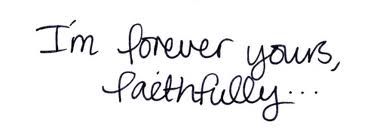
I'm forever yours, faithfully. Journey

I had an awesome opportunity to attend my good friend Shawne Duperon’s media boot camp this past week.  We connected when when she began working on Project: Forgive since I wrote about self-forgiveness in my dissertation.  The focus of media boot camp workshop was to get you feeling comfortable with being uncomfortable.

One of the exercises was to stand as close to a partner as possible and stare into the other [unknown person’s] eyes without saying anything for an unspecified period of time.  For many this exercise was unnerving and yet it was one of the easiest ones for me to complete.  After reflecting on this experience, I decided it would be an excellent opportunity for me to share this with my life partner.

I took the liberty of adapting the exercise by choosing a song to play that spoke to me about our relationship.  My partner and I have been in a long distant relationship going on a little over ten years, so for me the lyrics: "And being apart – Ain’t easy on this love affair – Two strangers learn to fall in love again – I get the joy of rediscovering you – Oh, girl, you stand by me – I’m forever yours – Faithfully!"

It was really hard to look into her eyes without tearing up but I wanted to share an intimate experience with her and develop a practice to keep us connected.  So my challenge for you is to do the same – pick a song, stand close to one another hold hands and say nothing – let your eyes speak the words you struggle sometimes to find…try to make it a daily practice!

Tuesday, August 20, 2013

Why is “no” the hardest message to receive in our intimate relationships?

The word “no” to one’s sexual advances triggers many different emotions for many people. For some, it is a flat out rejection that they are not masculine or feminine enough. It can foster an attitude of insecurity, jealousy and rattle one’s confidence. For some reason, we accept “no” in other areas of our life, but it becomes extremely personal in sex.

This fact only stresses the importance of communication in a relationship. With no explanation or discussion, one starts to fill in the blanks with incorrect assumptions which can lead to greater distance in the relationship.

We all place filters on the way we choose to hear messages. What are your filters and how do they affect your ability to hear a message? What changes do you need to make to hear a message differently? Instead of assuming that your partner is rejecting you, could it be that he/she is exhausted from a stressful day?

People who seriously want a stronger, healthier relationship exercise the communication muscle. This means taking advantage of the opportunities to express our feelings, especially ones we struggle with personally, and finding a way to express them to one’s partner.

  • Ask yourself, why am I being turned down ? What is going on for my partner to prevent them from being in the mood?
  • Talk with your partner about how you are feeling. Do they know that you are feeling rejected?
  • Communicate your feelings of rejection without the expectation that the only way for you to feel better is for them to give in to your desires.
  • Burying your feelings is not healthy; it is like ignoring a wound without treatment and hoping that it will get better.
If you are communicating with your partner, but the pattern of conflict continues, there may be deeper rooted issues in the relationship that could benefit from the help of a professional.

Friday, August 2, 2013

Life - it's all about attitude!

Recently I developed a relationship fitness program for couples utilizing a holistic approach to strengthen your relationship.   My belief is that the world is a better place when our relationships remain strong and healthy.  This approach is a seven-spoke model based on the number of days in the week.  The spokes include: communication, intimacy, lifestyle, nutrition, education, spirituality and environment.  The idea is for couples to pick a spoke they want to strengthen daily and find ways that are pleasurable and fun to improve their relationship.

There are no rules only suggestions – you prescribe the program that is right for you.

Today I would like to focus on attitude as an aspect of spirituality.  I view spirituality as the force that makes us human and something you can feel.  You cannot see, touch or taste it, but yet you know it is there, much like a breeze or the wind.  Viktor Frankl taught us in his famous text, Man’s Search for Meaning, that attitude is the one thing that no one gives us, no one can take away from us and the one thing that always remains our choice…so choose it wisely!  Our attitude affects our entire life and a positive attitude directly impacts not only our mental health but physical health as well.  

People ask all the time how do I go about changing my attitude?  The answer is simple but not always easy to implement and maintain.  Successful people choose an attitude of never giving up and so they don’t!  Others have been successful by enlisting the support and encouragement of those around them…asking them to point out anytime when they notice a fallback to a former negative attitude.  For those who are willing to “make it hurt”, they decided to pay a “fee” whether it be $1, $5, $10 or $20 every time someone catches them slipping backwards.  Be forewarned that our friends and family members can change when there are hard dollars involved.  Instead of being supportive and encouraging, they can set clever [and some not so clever] traps to catch us doing what we know best.

Think about the attitude you have in your relationship with your partner, spouse, significant other…how would you describe it…what words would you use?  Does your attitude serve to strengthen or weaken your most important relationship?  Why did / are you choosing it?  What value would there be if you decided to change it to improve how well you get along / stay connected to her/him?  I choose to have a positive attitude, what’s your choice?